Introduction
When people think of hackathon winners, they picture final year students with years of experience. We were first year students who finished in the top 69 teams out of more than 15,000 participants at the GO-BRICS Hackathon.
We were those first year students. And we finished in the top 69 teams out of more than 15,000 participants at the GO-BRICS Hackathon — Energy-O-Thon, an international bilateral hackathon connecting India and Russia under the BRICS framework.
This is the story of how that happened, what we built, and what it felt like to compete on a global stage before we even knew what we were fully capable of.
What is the GO-BRICS Energy-O-Thon?
Before I get into our journey, it's worth understanding the scale and significance of the platform we were competing on.
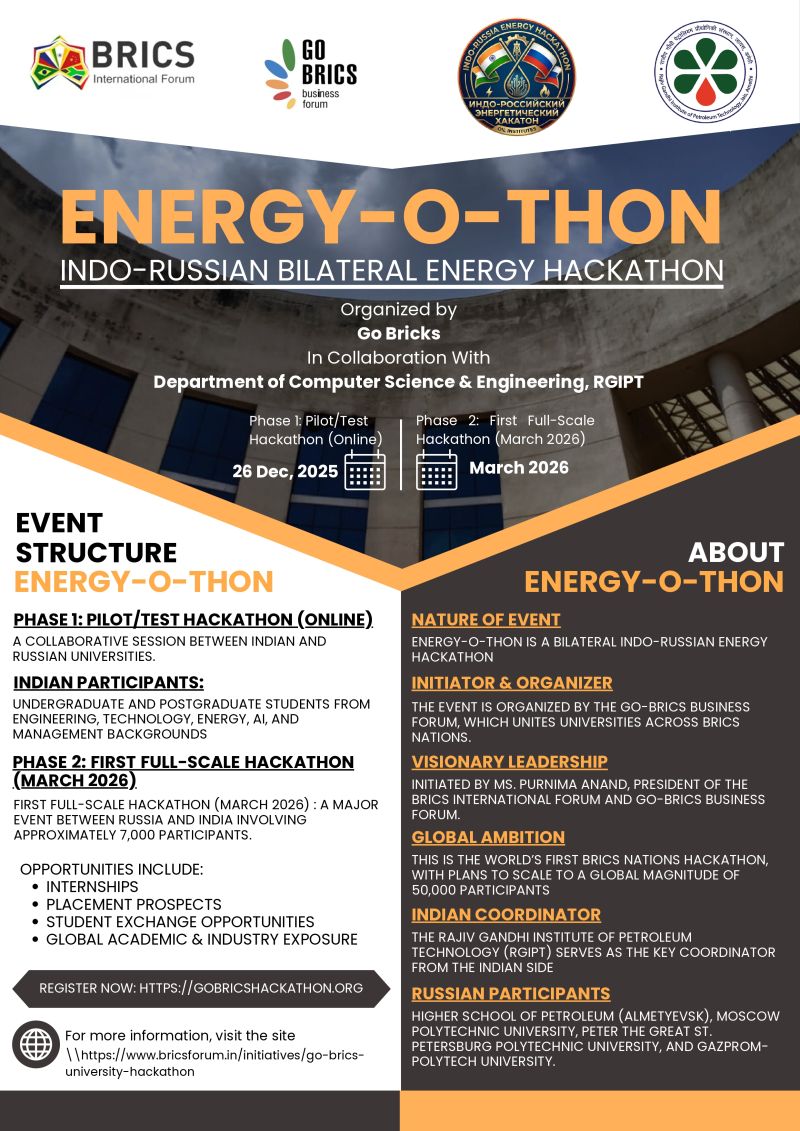
The GO-BRICS Hackathon, formally known as the Energy-O-Thon, is an international initiative organized by the GO-BRICS Business Forum, founded by Ms. Purnima Anand, President of the BRICS International Forum. It is not your typical college hackathon. It is a flagship platform that connects academic institutions, industry experts, and students across BRICS nations — primarily India and Russia — to build real-world digital, AI, and engineering solutions.
The problem statements span across some of the most critical domains of our time:
- Technology — AI, machine learning, predictive modeling, and industrial IoT
- Business — Cross-border procurement and global market scalability
- Sustainability & Energy — Oil and gas challenges, green energy transitions, and climate tech
- Social Impact — Open innovation tackling pressing global issues
The institutional anchors are equally prestigious. On the Indian side, the Rajiv Gandhi Institute of Petroleum Technology (RGIPT) led institutional support. On the Russian side, partners included Peter the Great St. Petersburg Polytechnic University (SPbPU), Moscow Polytechnic University, and the Higher School of Petroleum, Almetyevsk.
This was not a small student competition. This was a serious, international, multi-phase event with real-world stakes.
How We Got In — And Why We Even Tried
Honestly? We almost talked ourselves out of applying.
We were first year students. We didn't have polished portfolios, years of coding experience, or senior mentors guiding us. What we had was curiosity, a willingness to work hard, and the belief that showing up is always better than sitting on the sidelines.
When we came across the Energy-O-Thon, the scale of it was intimidating. International participants. Elite institutional partners. Problem statements rooted in real industry challenges. But we decided that even if we didn't win, competing at that level would teach us more than anything we'd learn inside a classroom.
So we registered. And we got to work.
The Hackathon: Two Phases, One Goal
The competition ran across two structured phases:
Phase 1 (December 2025) was an online pilot where teams submitted their initial digital solution concepts. This was our first real test — could we articulate a meaningful, technically grounded idea that would stand out among thousands of submissions from across the world?
We poured everything into that submission. We researched the problem space deeply, challenged our own assumptions, and refined our concept until we felt it was genuinely worth presenting.
It worked. We advanced.
Phase 2 (March 2026) scaled into the full flagship bilateral hackathon, drawing roughly 7,000 international participants into an intense, high-stakes build phase. This was where the competition truly began — and where we had to deliver not just an idea, but a solution.
What We Built
Our solution addressed one of the core focus areas of the hackathon — bringing together technology, sustainability, and real-world impact. We approached the problem not just as students trying to win a competition, but as people genuinely trying to answer a difficult question:
How can AI and digital innovation solve energy and sustainability challenges that matter at a global scale?
We built with that question at the center of everything. The technical architecture, the user experience, the business viability — every decision was grounded in whether it would actually work in the real world, not just look impressive on a slide deck.
The Result: Top 69 Out of 15,000+
When the results came out and we saw our team in the top 69, it took a moment to fully register.
15,000+ participants. Teams from across India and Russia. Students from premier institutions with far more experience and resources than us. And we — first year students from Yenepoya University — were standing in the top bracket.
It was one of those moments that quietly but permanently shifts how you see yourself.
What This Experience Taught Me
You Don't Need to Be Ready — You Need to Start
We were not ready for an international hackathon in our first year by any conventional measure. But readiness is often built in the process of doing, not before it. Applying before we felt prepared was the best decision we made.
Depth Beats Speed
In a competition with thousands of teams, the ones that stand out are not the ones who move the fastest — they are the ones who think the deepest. We spent more time understanding the problem than building the solution, and that paid off.
First Year Is Not Too Early
If you are a first year student reading this and wondering whether you are too early in your journey to compete at a high level — you are not. The gap between you and more experienced competitors is smaller than you think, and the experience of competing closes it faster than anything else.
Global Problems Need Global Thinking
Competing alongside students from Russia, engaging with problem statements rooted in international energy and sustainability challenges, and being evaluated by industry experts across borders expanded how I think. It made my perspective bigger. That is something no textbook can do.
Your Team Is Everything
None of this happened alone. The team I competed with brought different strengths, pushed through late nights, and held each other accountable when motivation dipped. Whatever credit belongs to this achievement belongs equally to every one of them.
Looking Forward
Finishing in the top 69 at the GO-BRICS Energy-O-Thon is something I carry with quiet pride. Not as a trophy to display, but as proof — to myself, more than anyone — that ambitious goals are worth chasing, even when the odds look overwhelming.
We are just getting started. This was our first year. There are more problems to solve, more competitions to enter, and more ideas to build. If anything, this result has raised the bar we hold ourselves to.
To every student who has ever hesitated to apply for something because they thought they weren't ready enough, experienced enough, or qualified enough — apply anyway. The worst outcome is a lesson. The best outcome might just surprise you.
Thank You
To my team — this is ours, not mine. To Yenepoya University for the environment that encouraged us to reach beyond campus boundaries. And to the GO-BRICS Business Forum and Energy-O-Thon for creating a platform that gives students like us a genuine shot at competing on the world stage.
— Anand Mahadev First Year Student | NIAT Yenepoya University GO-BRICS Energy-O-Thon — Top 69 | 15,000+ Participants