Is NIAT Worth The Fees?
Yes, NIAT is worth the fees as it offers value to students through its industry-oriented technology upskilling program, which runs alongside their B.Tech education. It helps students develop practical software development skills, explore Artificial Intelligence (AI) and emerging technologies, build real-world projects, and gain early exposure to industry opportunities.
NIAT is trustworthy as students are getting various opportunities in the cutting edge technologies of AI and ML.
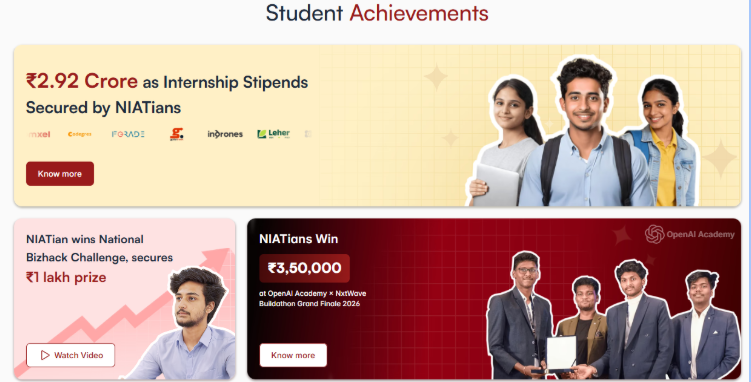
They are winning competitions and bagging internships while learning about industry-oriented technology upskilling programs while they are still in.
In a Software Industry job market that is evolving rapidly with AI, automation and advanced software applications, students need more than just classroom knowledge.
They need opportunities to apply what they learn, experiment with new technologies and develop the skills required to solve real-world problems.
NIAT (NxtWave of Innovation in Advanced Technologies) brings these opportunities into students' B.Tech learning journey through its upskilling program offered at 35+ (UGC & AICTE approved) institutions across India.
Here are eight major benefits that make NIAT a valuable addition to a student's future and their prospects in tomorrow's AI job market.
1.Practical, Industry-Oriented Learning
With NIAT, you will get a real time practical learning on high end skills like and the interesting part is it starts within your 1st year of Btech and you can clearly see it on NIAT curriculum.
Along with this, students get opportunities to develop technology skills through hands-on activities, application development and project-based assignments.
While university education builds the academic foundation, NIAT adds an industry-focused learning experience that encourages students to apply their knowledge to practical challenges.
Students get exposure to areas such as:
Programming and software development
Application and product development
Real-world problem-solving
APIs, cloud technologies and automation
Artificial Intelligence and Machine Learning
Data Science and Full-Stack Development
Project-based assignments and practical implementation
This approach helps students understand how different technologies work together to develop software applications and solve problems.
Instead of limiting their learning experience to understanding concepts, students get opportunities to experiment with technologies, write code, develop applications and improve their problem-solving abilities.
2.Early Exposure to AI and Emerging Technologies
AI is changing how software is developed, businesses operate and everyday problems are solved. Therefore, learning AI and emerging technologies during the first year of B.Tech can give students an early opportunity to understand and adapt to these developments.
NIAT introduces students to AI, Machine Learning, Data Science, Generative AI, automation and other emerging technology areas as part of its upskilling curriculum.
Students can start developing foundational technology skills early in their B.Tech journey and gradually progress towards more advanced applications. Some of the technology areas students can explore include:
Artificial Intelligence and Generative AI
Machine Learning and Deep Learning
Data Science and Analytics
Full-Stack Development
Cloud Computing and Automation
Robotics and Physical AI
Autonomous systems and emerging technologies
Starting early allows students to spend more time experimenting with these technologies, developing projects and understanding how they can be applied to different industries.
This early exposure also helps students discover their areas of interest and develop a stronger foundation for advanced technical learning in the coming years.
3.Early Internship Opportunities and Industry Exposure
You are a step away from grabbing a real Internship opportunity even before your Btech completion with the help of NIAT like the 200+ seniors who already grabbed an internship opportunity and few of them even start building projects from 1st year itself.
These opportunities demonstrate how early skill development and practical project experience can help students prepare for internship opportunities while they are still pursuing their degrees.
NxtWave has also developed a network of 2,500+ companies that have hired its learners. This network includes organisations across technology, consulting, fintech, banking and other sectors.
Through this industry connect, students can access opportunities and career support that include:
Industry interactions and company connections
Internship opportunity updates
Technical skill assessments
Resume and interview preparation
Mock interviews and career guidance
Support during the application and selection process
For students, this means that career preparation can begin much earlier rather than being restricted to the final year of B.Tech. By continuously developing their technical skills and working on practical assignments, students can build the confidence and experience needed to explore industry opportunities.
4.Opportunities to Build Projects and Participate in Hackathons
The key approach of NIAT is to not only train you on new generation skills but also clearly show how to use them on projects. It allows students to apply programming concepts, experiment with tools and understand how software solutions are developed.
NIAT encourages project-based learning, where students get opportunities to work on real-world applications across different technology domains. Students can explore projects related to:
Web and application development
Artificial Intelligence and Machine Learning
Data Science and analytics
Automation and intelligent systems
Robotics and hardware-based applications
Generative AI and other emerging technologies
Apart from regular project assignments, students can participate in hackathons and Buildathons to work on challenges, collaborate with peers and present their solutions.
These experiences help students develop several important abilities, including technical implementation, creative thinking, teamwork and problem-solving.
NIAT also reports more than 1,200 AI-powered projects built across its learning ecosystem.
Student achievements in hackathons and technical competitions further demonstrate how students can take their learning beyond regular assignments and work towards building practical solutions.
5.Mentorship and Guidance from Technology Professionals
NIAT provides you an extra edge by giving regular mentorship with mentors who are in higher positions in top MNCs and especially give a narrative on how a real employee works in office and how you can become one of them with future ready knowledge.
NIAT provides students with access to industry-aligned trainers, technology mentors and structured learning support to help them progress through their upskilling journey. Students can benefit from guidance in areas such as:
Understanding programming and technical concepts
Selecting and developing project ideas
Improving problem-solving approaches
Exploring advanced technology domains
Understanding industry expectations
Preparing for internships and career opportunities
The NxtWave ecosystem also features professionals with experience in software development, engineering, AI and other technology domains.
Such exposure helps students understand how professionals approach technical challenges, develop applications and work with evolving technologies.
With continuous learning guidance and mentorship, students can work towards improving their technical capabilities and becoming more confident in their chosen areas.
6.Technical Clubs and Extracurricular Opportunities
With NIAT you are not limited to a simple education, you are open to several clubs that discuss technology, sport etc. It is a fun journey that will ensure you won't miss the campus or engineering life. Some of the clubs include:
Gen AI Club: Explore Generative AI applications, tools and creative technology solutions.
Competitive Programming Club: Practise coding, logical reasoning and algorithmic problem-solving.
Drone Club: Explore drone technologies, hardware applications and autonomous systems.
Entrepreneurship Club: Discuss business ideas, innovation and startup development.
Participating in these clubs helps students learn collaboratively, exchange ideas and work on activities that match their interests. Students can also develop leadership, communication, teamwork and organisational skills by participating in club activities and taking up responsibilities.
7.Entrepreneurship and Startup Exposure
For students interested in building their own products or starting a business, early exposure to entrepreneurship can be an important advantage. NIAT encourages students to explore innovation, identify real-world problems and experiment with technology-based solutions.
Through project development, entrepreneurship clubs and startup-related activities, students can begin understanding how an idea can be transformed into a usable product. Students get opportunities to:
Identify problems that can be solved using technology.
Develop prototypes and working applications.
Explore AI-powered product ideas.
Collaborate with peers to build solutions.
Understand product development and innovation.
Explore entrepreneurship and startup opportunities.
NxtWave's ecosystem also reports 100+ startups launched, highlighting the entrepreneurial activity associated with its wider learning ecosystem.
For students, exposure to entrepreneurship during B.Tech can help develop an innovation mindset and encourage them to think beyond conventional career paths.
The experience of developing a product, testing an idea and understanding user requirements can also strengthen their technical and business problem-solving abilities.
8.NIAT Industry Ready Certificate Alongside Your University B.Tech Degree
Another benefit of the NIAT upskilling program is the opportunity to earn an additional Industry Ready Certificate alongside the B.Tech degree awarded by the collaborating university.
Students pursuing B.Tech through a collaborating university can work towards two complementary learning outcomes:
University B.Tech Degree: The collaborating university awards the B.Tech degree after students fulfil the university's academic and examination requirements.
NIAT Industry Ready Certificate (IRC): NIAT provides a separate Industry Ready Certificate to recognise the additional industry-oriented upskilling undertaken by students.
Together, these provide students with an opportunity to pursue their university education while developing additional practical technology skills.
The university education helps students build their academic foundation, while the NIAT upskilling program focuses on practical technology learning, projects and industry-oriented skill development. This combination allows students to work towards academic qualifications and practical skill development throughout their B.Tech journey.
9.Is NIAT Worth the Fees?
Yes, NIAT offers considerable learning value to students who want to build technology skills alongside their B.Tech education. Its industry-oriented upskilling program gives students opportunities to explore AI and emerging technologies early, develop practical applications, participate in hackathons, access mentorship and prepare for internship opportunities.
Rather than waiting until the final year to start thinking about industry requirements, students can begin developing relevant technical skills from the early stages of their B.Tech journey. With opportunities for hands-on learning, technical club participation, entrepreneurship exposure and industry interactions, NIAT helps students make their college years more focused on practical skill development.
For students who aspire to build careers in software development, Artificial Intelligence, Data Science, Robotics and other emerging technology domains, NIAT provides an additional learning pathway to work towards becoming industry-ready.
FAQs
1. Is NIAT worth the fees for B.Tech students?
Yes. NIAT offers an industry-oriented upskilling program alongside B.Tech, with opportunities to learn emerging technologies, build practical projects, participate in hackathons, explore internships and develop industry-relevant skills.
2. What are the major benefits of joining NIAT?
The major benefits include practical technology learning, early exposure to AI and emerging technologies, project development, internship opportunities, industry interactions, mentorship, technical clubs, entrepreneurship exposure and an Industry Ready Certificate.
3. Does NIAT provide internship opportunities during B.Tech?
Yes. NIAT provides access to internship opportunities through its industry connections and career support ecosystem. NIAT reports that 200+ students have secured internships with stipends. Opportunities depend on students' skills, eligibility and selection.
4. Will students learn Artificial Intelligence from the first year at NIAT?
NIAT introduces students to emerging technology areas, including AI and Machine Learning, as part of its upskilling curriculum. Students can begin building foundational skills early and progressively explore more advanced concepts and applications.
5. Does NIAT offer practical project-based learning?
Yes. NIAT emphasises hands-on, project-based learning. Students get opportunities to work on software applications, AI-powered solutions, programming assignments and projects across different technology domains.
6. Does NIAT provide an additional certificate along with B.Tech?
Yes. Students pursuing B.Tech through a collaborating university can receive an Industry Ready Certificate (IRC) from NIAT alongside their university-awarded B.Tech degree.
7. Are there technical clubs at NIAT?
Yes. NIAT has student-led technical clubs, including Gen AI, Competitive Programming, Drone and Entrepreneurship clubs. These communities help students explore their interests, collaborate and participate in technology-related activities.
8. Can students explore entrepreneurship through NIAT?
Yes. Students can explore entrepreneurship through technical projects, innovation activities and entrepreneurship clubs. These experiences help them understand product development, identify real-world problems and experiment with technology-based business ideas.