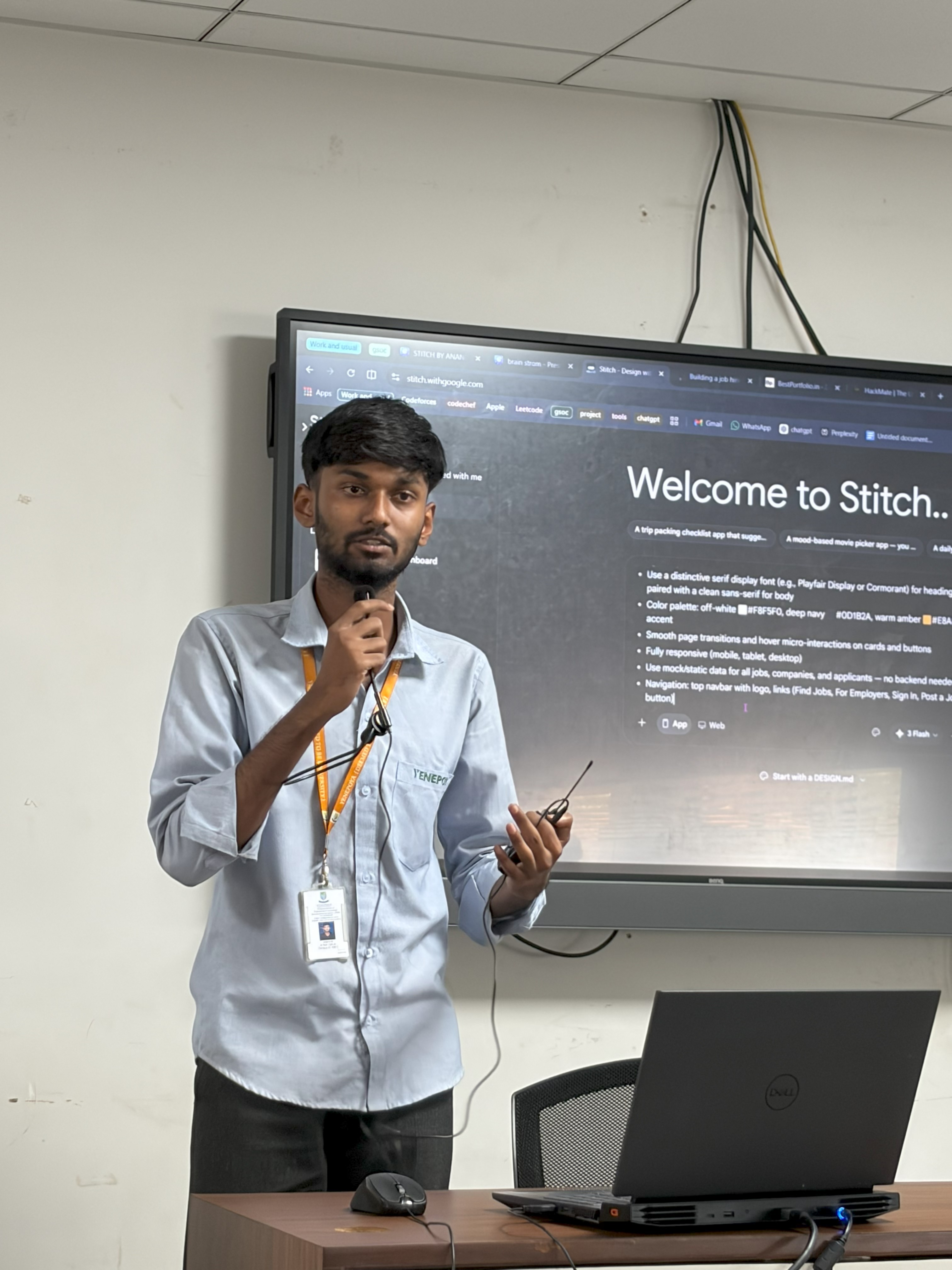
A few days ago, I mentored students at the NIAT Tech Club, Yenepoya University — and it was one of the most energizing experiences I've had as an AI practitioner. Walking into a room full of curious, eager students and watching them transform from complete beginners to confident AI builders in just one session reminded me exactly why I love what I do.
In this article, I want to share what we covered, what the students learned, and why I believe hands-on AI education like this is absolutely critical right now.
Why This Session Mattered
We are living in a moment where AI tools are not a distant future — they are here, they are powerful, and they are accessible to anyone willing to learn. Yet most students are still being taught to build things the old way, without ever being exposed to the tools that are already reshaping the industry.
That gap is exactly what I wanted to close.
The NIAT Tech Club gave me the platform to do that, and I'm genuinely grateful for the invitation. The students were sharp, the energy in the room was electric, and by the end of the session, ideas that once felt impossible were suddenly very real and very buildable.
What We Covered
AI-Assisted Development
I started by reframing how students think about writing code. AI-assisted development is not about replacing the developer — it's about making the developer dramatically more powerful. We explored how AI can handle boilerplate, suggest architecture, catch bugs, and even explain complex code in plain English.
Prompt Engineering
This was one of the most eye-opening parts of the session. Students quickly realized that talking to an AI is a skill. The quality of what you get out depends entirely on the quality of what you put in. We practiced writing prompts that were clear, structured, and context-rich — and the difference in output quality was immediate and visible.
Workflow Automation
I showed students how to think about their daily tasks differently — identifying what's repetitive, what's predictable, and what can be handed off to an AI-powered workflow. This mindset shift alone can multiply productivity several times over.
Rapid Prototyping
This was the crowd favorite. I demonstrated how you can go from a raw idea to a working, functional prototype in a matter of hours using modern AI tools. Students were genuinely amazed at how fast the build cycle has become when AI is part of the process.
Tools I Introduced
Google Stitch
A powerful AI design tool that converts ideas and wireframes directly into functional UI components. I showed students how Stitch collapses the gap between design and development, making it perfect for rapid prototyping and solo builders.
Claude Code
Anthropic's AI coding assistant that lets you write, debug, and refactor code using natural language. I use Claude Code regularly in my own workflow, and seeing students interact with it for the first time — watching the moment it clicks — was genuinely satisfying.
Google AI Studio
A platform for experimenting with Google's Gemini models and building AI-powered applications. I walked students through how to test prompts, build simple AI apps, and use the API to integrate AI into their own projects — no deep ML background required.
What the Students Built and Discovered
By the end of the session, students weren't just observers — they were experimenters. They were building, breaking things, asking sharp questions, and coming up with project ideas on the spot. A few key things they discovered:
- Speed is now a superpower. With the right AI tools, the time from idea to prototype has shrunk dramatically.
- Communication is a technical skill. Prompt engineering taught them that articulating your intent clearly is just as important as knowing how to code.
- AI rewards curiosity. The more they experimented, the better their results got.
- Collaboration accelerates everything. Working together with AI — and with each other — made the impossible feel routine.
My Reflection as a Mentor
What struck me most was not how quickly students picked up the tools — it was how quickly they started thinking like builders. That shift in identity, from "student learning theory" to "creator solving real problems," happened right in front of me. That is the real outcome of a session like this.
I always say: the best way to learn AI is to use AI. Not to study it from a distance, but to get your hands on it, break things, and build something you're proud of. That is exactly what the students at NIAT did.
A Note of Gratitude
A huge thank you to the NIAT Tech Club and the Yentech Community for organizing this session and trusting me to mentor such a talented group of students. The hospitality, the enthusiasm, and the curiosity in that room were truly something special. I hope this is just the beginning of a long collaboration.
To the students — keep building. Keep experimenting. The tools are in your hands now. Use them.
Final Thoughts
If you are a student reading this, my message is simple: do not wait to start. The AI revolution is not coming — it is already here. The students who learn to work with these tools today will be the ones building the future tomorrow.
And if you are an institution or tech club looking to bring this kind of hands-on AI session to your campus, feel free to reach out. There is nothing more rewarding than watching young minds discover what they are truly capable of.
— Anand Mahadev AI Practitioner | Mentor | Builder