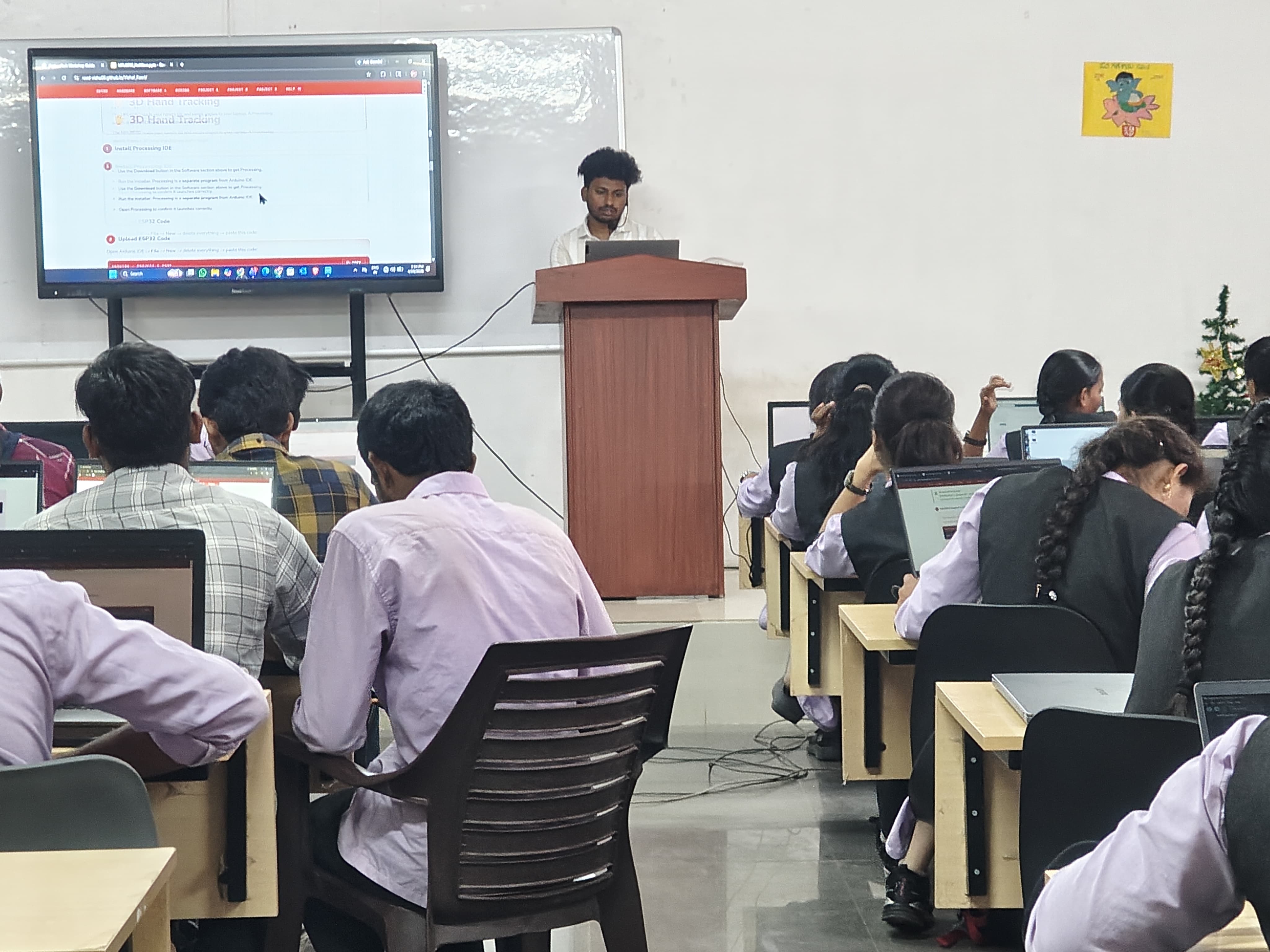
Controlling something with a hand gesture sounded like science fiction until our workshop at NIAT. As Gen AI Club President—and part-time chaos manager 😄—I volunteered for a session led by Vamsi sir that mixed learning with plenty of “why is this not working?” moments.
A Demo, Then Wires Everywhere
The idea sounded simple: help students control systems using gestures. Vamsi sir’s demonstration got everyone’s attention. Then came the hands-on work: laptops, connections and a familiar question every few minutes—“Sir, why is my LED not glowing?”
“Bro, check my connection” and “I think my ESP32 is judging me” captured the mood pretty well. As volunteers, we moved around checking circuits, fixing loose wires and explaining the same steps again. Watching a student finally get a response made it worthwhile.
What We Used and Built
The workshop used:
- ESP32 microcontrollers
- Sensors to detect motion
- Arduino IDE for coding
The basic sequence was straightforward: a sensor captured movement, data reached the system, code interpreted the gesture and an output responded. An LED turning on or off was one of those visible results. Your hand had become part of the control.
The Moments That Made Us Laugh
One student celebrated a working LED as if he had cracked GSoC. Another connected wires in a way that seemed wrong to us, yet somehow got a response. Meanwhile, Vamsi sir calmly fixed in seconds what had kept us busy for twenty minutes.
Those moments made the technical work feel approachable, even when it was frustrating.
What Volunteering Taught Me
I was learning alongside the students. Helping meant managing people and problems at the same time, staying calm and finding simpler ways to explain technical ideas.
My most persistent troubleshooting reminder from the day: check the GND connection early.
Leaving With More Than a Working Circuit
For me, the workshop made gesture control feel like something we could explore in a classroom. The memory is a mixture of teamwork, working LEDs, loose wires and laughter. And next time, we are bringing extra kits. Definitely.
Frequently Asked Questions
What tools did we use in the workshop?
The account names ESP32 microcontrollers, motion sensors and Arduino IDE for coding.
What did the gesture-control system do?
Sensors captured movement, code interpreted the data and an output responded, such as an LED turning on or off.
What did volunteering teach me?
I practised explaining technical ideas, checking connections and staying calm while helping several students troubleshoot.
Who led the gesture-control workshop?
Vamsi sir led the session. I helped as a volunteer while serving as Gen AI Club President.
What troubleshooting problems did volunteers help with?
We checked circuits, fixed loose wires and helped students understand why their setup was not responding. Checking the GND connection became a memorable reminder from the day.