Yes, adding NIAT’s Upskilling Value and IRC to your BTech CSE journey is always beneficial than just pursuing BTech Engineering from a Tier-2 or Tier 3 college.
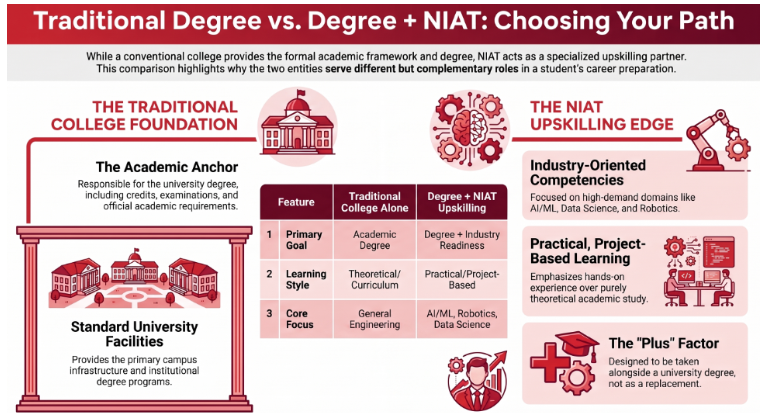
NIAT is an upskilling program by NxtWave, focused on practical, industry-oriented technology skills alongside a university degree awarded by a collaborating university. A private engineering college, on the other hand, provides the degree and manages the academic engineering program.
The meaningful comparison is therefore not NIAT versus a college in isolation, but a university degree with NIAT upskilling versus the specific engineering college being considered. Students should compare practical learning, projects, internships, placement support, industry exposure, campus experience and total cost before making a decision.
NIAT vs Tier-2/Tier-3 Private Engineering College: Quick Comparison
Choosing between NIAT and a Tier-2/Tier-3 private engineering college involves comparing more than the college category or degree. NIAT is an upskilling program that adds structured, industry-oriented technical training alongside a degree awarded by a collaborating university, while a conventional engineering college primarily focuses on university-led engineering education.
The right comparison should therefore consider factors such as learning approach, practical projects, industry exposure, internships, placement support, campus experience and total cost.
Factors | NIAT Upskilling Program | Typical Tier-2/Tier-3 Private Engineering College |
|---|---|---|
Degree | Degree is awarded by the collaborating university, not NIAT | Degree is awarded by the respective university |
Primary focus | Industry-oriented skill development alongside the university degree | University-led academic engineering education |
Learning approach | Structured upskilling, projects, practical learning and industry-aligned training | Varies significantly by college |
Technical skills | Strong focus on current technology areas and practical skill development | Depends on curriculum, faculty and student's self-learning |
Projects | Project-based learning is a major part of the upskilling model | Project exposure varies by college and department |
Industry exposure | Designed around industry-aligned skills and practical application | Depends on college-industry relationships and activities |
Internship exposure | NIAT provides pathways and support, subject to eligibility and performance | Depends on college, student effort and external opportunities |
Placement support | NxtWave provides placement support; employment is not guaranteed | Depends on the individual college's placement ecosystem |
Faculty/mentors | NIAT trainers, mentors and success coaches for upskilling | University/college faculty for the degree program |
Academic curriculum | Separate from the university's degree curriculum | University/college curriculum |
Campus experience | Takes place through the collaborating university's facilities | Directly provided by the college/university |
Flexibility across colleges | NIAT's model is offered through multiple collaborating institutions | Experience depends entirely on the selected college |
Cost | University degree fees + applicable NIAT upskilling fee and other expenses | College/university fees and other applicable expenses |
Best suited for | Students who want structured technical upskilling alongside their degree | Students who prefer a conventional engineering college model |
Why Should a Student Choose NIAT Instead of Tier 2 or Tier 3 Engineering Colleges?
The choice between NIAT and a conventional Tier-2 or Tier-3 engineering college depends on a student's learning preferences, career goals and the opportunities available through the specific college. NIAT is an upskilling program, rather than a degree-awarding institution, and is designed to provide structured, practical technology training alongside a university degree. Students may consider NIAT for the following reasons:
Industry-oriented technical learning: NIAT focuses on practical technology skills in areas such as programming, software development, AI, ML, data science, cloud and automation.
Project-based learning: Students get structured opportunities to work on projects and capstone assignments, helping them apply concepts beyond classroom learning.
Evolving Skill Map: NIAT's Skill Map is designed to evolve with changing technology and industry requirements, providing exposure to current technical areas.
Structured upskilling alongside a degree: Students can pursue the university's B.Tech degree while undertaking NIAT's separate upskilling program.
Dedicated mentors and trainers: The upskilling model includes trainers, mentors and support structures focused on technical learning and student progress.
Practical technology exposure: The program emphasises hands-on learning and the application of technologies rather than relying only on theoretical coursework.
Career and placement support: NxtWave provides career and placement support to eligible students, although participation does not guarantee an internship or job.
Additional industry exposure: NIAT's model is designed to connect learning with industry practices through projects, technology-focused activities and career preparation.
Industry Ready Certificate: Students who complete the applicable requirements can receive an Industry Ready Certificate (IRC) from NIAT, separate from the university degree.
Multiple collaborating universities: NIAT's upskilling model is available through multiple collaborating institutions, giving students different university and location options to evaluate.
What Is the Main Difference Between NIAT and a Tier-2 or Tier-3 College?
The main difference between NIAT and a Tier-2 or Tier-3 engineering college lies in their roles rather than simply their perceived category. A conventional engineering college manages the university degree and its academic requirements, while NIAT is an upskilling program focused on practical, industry-oriented technology skills alongside the degree. Therefore, students should compare the overall model of traditional engineering education with university degree with structured NIAT upskilling, rather than treating NIAT as a replacement for the college.
NIAT vs Tier-2/Tier-3 College: Comparison by Key Criteria
A comparison between NIAT and Tier-2/Tier-3 engineering colleges should focus on the actual learning and career ecosystem, rather than relying only on college-tier labels. Key factors include the degree-awarding university, industry-oriented learning, projects, internships, placement support, mentoring and campus experience. The advantages can also vary depending on the specific collaborating university and the engineering college being compared.
1. Degree and Academic Recognition
NIAT does not award a B.Tech degree. Students pursuing a degree through a collaborating university receive their degree from that university, subject to its admission requirements and academic rules. NIAT provides complementary skill development rather than replacing the university's degree program.
A student joining a private engineering college directly also receives the degree from that university or degree-awarding institution.
2. Industry-Oriented Learning
NIAT's Skill Map states that its industry insights are informed by inputs from 3,000+ companies, 10,000+ technology professionals and in-house R&D and product development. These insights are used to inform the upskilling program and are also shared with collaborating universities.
In a conventional private engineering college, the extent of industry alignment can vary considerably. And in some of the colleges, the curriculum is not updated as well. However, some colleges have strong industry partnerships, active technical clubs, experienced faculty and regular industry interaction. Others may provide a more conventional academic experience where students need to build most industry-relevant skills independently.
3. Projects and Practical Exposure
Projects are increasingly important for students targeting software, AI, data, automation and other technology roles.
NIAT's model places emphasis on hands-on learning and real-world projects. Its official website currently highlights opportunities to work on industry projects, subject to eligibility criteria.
A conventional college can also provide excellent project exposure, but the experience depends heavily on the department, faculty, student clubs and the student's own initiative.
4. Internships
Internships can help students understand how technical skills are applied in real work environments.
NIAT's model includes internship and career-oriented support, but participation and outcomes depend on eligibility, skills and performance. NIAT itself states that enrollment does not guarantee an internship or job.
In a tier-2 or tier-3 college, internship opportunities similarly depend on the institution's industry connections as well as the student's ability to find opportunities independently.
Students from lower-tier colleges may have difficulty securing internships, indicating that individual skills, projects, networking and consistency can substantially influence outcomes.
5. Placement and Career Support
Placement is often the most important factor behind the tier-2 versus tier-3 debate.
However, a college's highest package alone is not enough to judge its placement ecosystem. Students should examine:
Placement percentage
Median or average package
Number of students eligible for placements
Number of recruiters
Roles offered
Branch-wise placement data
Internship-to-job conversion
Companies recruiting repeatedly
Off-campus opportunities
NIAT NxtWave has had 2,500+ companies hire its learners across its programs, while also clarifying that the displayed outcomes cover multiple NxtWave programs and that NIAT enrollment itself does not assure employment.
A conventional engineering college may have a stronger placement ecosystem in a particular city, branch or recruiter segment. Another may have limited campus recruitment.
6. Learning Support
A conventional college generally provides university faculty for the academic degree program.
NIAT has a separate upskilling structure involving trainers, mentors and success coaches.
This distinction can matter for students who need additional guidance in areas such as coding, projects, technical problem-solving and career preparation.
However, students who are comfortable with self-learning may find that they can build similar skills through external courses, projects, communities and internships.
7. Campus Life and College Experience
Students choosing a private engineering college directly typically experience the college's:
Clubs and societies
Sports
Cultural activities
Events
Student communities
Campus infrastructure
Hostel environment
Alumni network
NIAT's purpose is different. Its upskilling program is conducted through collaborating institutions rather than operating as a separate degree-awarding college with its own academic campus. NIAT currently lists its program across 35+ institutions in 15 cities.
Therefore, students who strongly value campus life should evaluate the specific collaborating university, not NIAT alone.
Who Should Consider NIAT?
NIAT may be worth considering for students who:
Want a university degree along with structured technical upskilling
Prefer practical and project-based learning
Want to start building technology skills early in the degree
Are interested in areas such as AI, ML, data science, robotics and software development
Prefer guided learning instead of relying entirely on self-study
Want structured career and placement support
Are comparing NIAT with a private college that has limited industry exposure
Who May Prefer a Traditional Private Engineering College?
A conventional engineering college may be a better fit for students who:
Have identified a college with strong placements and industry connections
Prefer a traditional campus experience
Want a strong alumni network
Have access to strong technical clubs and student communities
Prefer greater flexibility in how they develop technical skills
Can independently learn modern technologies through projects, internships and external resources
Conclusion
NIAT can be a better fit than a tier-2 or tier-3 private engineering college when the student values structured technical upskilling, practical projects, industry-aligned learning and career support alongside a university degree. The better comparison is NIAT + its collaborating university versus the specific private engineering college being considered.
If the private college already offers strong placements, practical projects, internships, industry exposure, technical communities and a good return on fees, it will still be better to add IRC from NIAT. But still students can choose the private colleges.
If the college provides the degree but leaves most industry-oriented skill development to the student, NIAT's structured upskilling model may offer additional value.
Ultimately, students should compare actual outcomes, total cost, learning opportunities and career support rather than choosing solely on the basis of a tier label.
FAQs
1. Is NIAT better than a tier-3 college?
Yes, NIAT can be a stronger option when compared with a private engineering college that has limited practical learning, industry exposure, projects or career support. However, the specific university and college should be evaluated rather than relying only on the tier-3 label.
2. Does NIAT guarantee placement?
No. NIAT's enrollment does not guarantee a job or internship. Placement outcomes depend on factors including the student's skills, performance and effort.
3. Is NIAT better than a good tier-2 private college?
Not necessarily. A strong tier-2 college may already provide good placements, internships, industry exposure and campus opportunities. NIAT should be compared with the specific college on these criteria rather than judged against the tier label alone.
4. Does NIAT provide internships?
NIAT's upskilling model includes internship-related opportunities and support, subject to applicable eligibility and performance requirements. Students should check the specific opportunity and its eligibility conditions rather than assuming that enrollment guarantees an internship.
5. What should students compare before choosing NIAT?
Students should compare the degree-awarding university, total fees, placement data, internship opportunities, project exposure, technical learning, industry connections, campus experience, location and career support.