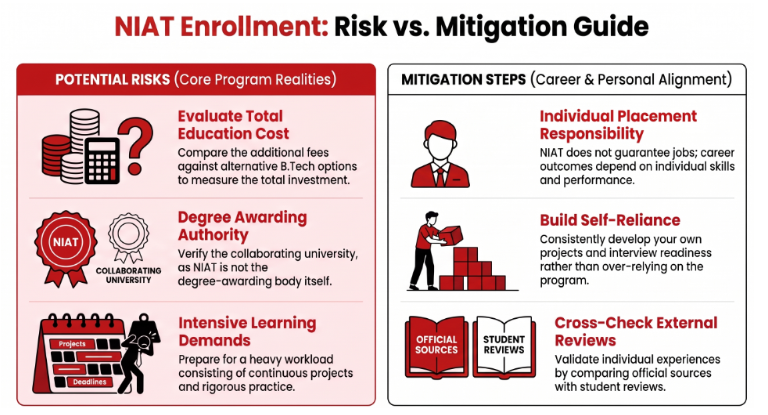
The biggest risk of joining NIAT is paying a significant amount for an upskilling programme without first evaluating whether its additional learning and outcomes justify the overall cost for the student. Also, not understanding the real goal of NIAT and strenuous learning hours along with handling both the Upskilling program and BTech degree from collaborating University.
NIAT is an upskilling program by NxtWave, conducted alongside a student's university education. Therefore, the decision is not simply about choosing a B.Tech degree. Students and parents also need to evaluate the additional upskilling fee, learning intensity, university, expected career outcomes, and the student's willingness to consistently participate in the programme.
This does not mean that NIAT is unsuitable for every student. The risk is higher when a student joins primarily because of expectations of guaranteed placements, internships, premium mentoring, or a quick return on the money spent.
The biggest risk is a mismatch between the student's expectations and what the NIAT upskilling programme can realistically deliver for that individual.
For example, a student may expect that paying the programme fee will automatically lead to a job, internship, or high salary. However, NIAT itself states that enrollment does not assure a job or internship and that outcomes depend on factors including student effort, skills, and performance.
This makes expectation-setting one of the most important considerations before enrollment.
A student who understands NIAT as an additional skill-building programme and is prepared to put in consistent effort may view the model differently from a student who expects the programme itself to guarantee a career outcome.
1. Students May Confuse NIAT With the University Degree
This is a very important risk, particularly for students and parents who do not clearly understand the structure.
NIAT does not award the B.Tech degree. The degree comes from the collaborating university, while NIAT provides the additional upskilling programme. Therefore, students should not assume that NIAT itself is the university, degree-awarding body, or academic institution. The collaborating university remains responsible for its own admission process and degree requirements.
How to reduce this risk?
Learn about NIAT, talk to the current NIATians, check the NIAT official website, and read about it on the Internet. Before paying any fee, students should clearly identify:
Which university awards the B.Tech degree
The exact B.Tech programme
University eligibility criteria
University admission requirements
University academic requirements
University fees
Separate NIAT upskilling fees
The credential provided by NIAT
2. Career Expectations Can Become a Risk
Another major risk is assuming that joining NIAT automatically improves career outcomes. However, many NIATians have secured paid Internships in their first year. These Internships are based on students’ efforts and skills, performance, and AI oriented solutions that they develop.
NIAT gives them all kinds of opportunities and guidance, but it is the students who put the real effort. NIAT's own placement information says that joining NIAT does not assure a job or internship. That distinction matters because technology careers are influenced by several factors:
Coding ability
Problem-solving skills
Projects
Interview performance
Communication skills
Internship experience
Academic performance
Job-market conditions
Individual effort
Therefore, NIAT should not be treated as a guaranteed placement route.
How to reduce this risk?
Students should evaluate NIAT based on the learning opportunity rather than a guaranteed salary or placement outcome. Before enrollment, it is useful to ask:
What exactly is guaranteed and what is not?
Are internship opportunities guaranteed?
Are placement outcomes being quoted specifically for the relevant NIAT university cohort?
What effort is expected from the student?
What happens if the student does not meet the required skill level?
3. The Programme May Be Too Intensive for Some Students
NIAT's model places significant emphasis on practical and technology-oriented learning. That can be beneficial for students who enjoy coding, projects and continuous practice. However, it can also become a challenge for students who prefer a slower or more conventional academic routine. Moreover, the NIAT skill map is more aligned toward the coding subjects and AI, ML, and Data Science. Students not interested in these sectors will find it intensive to grasp.
Some students describe the project-based and practical approach positively, while others raise concerns about workload and the overall experience. The key point is that the same learning intensity can be an advantage for one student and a disadvantage for another.
How to reduce this risk?
Students should realistically assess whether they are prepared to:
Practise coding regularly
Complete projects
Learn outside scheduled sessions
Keep up with training modules
Work consistently over several years
Balance university requirements with NIAT's upskilling programme
Students who strongly dislike continuous technical practice may find the model difficult to sustain.
4. Financial Risk: The Additional Cost May Not Suit Every Student
One of the clearest risks is financial. NIAT involves an upskilling fee in addition to the fees associated with the collaborating university's degree programme. This means the total cost should be evaluated as a complete education investment rather than looking at the NIAT fee separately. The total cost for the 4 year duration is within the range of INR 8 Lakhs - INR 8 Lakhs, depending on the collaborating university and the facilities available.
A student who is highly motivated to build technology skills and make extensive use of the additional learning may derive more value than a student who would prefer a conventional university experience and self-directed learning.
How to reduce the financial risk
Before enrolling, students should compare:
Total university fee
NIAT upskilling fee
Hostel and living expenses, where applicable
Other education-related costs
What is included in the upskilling programme
The exact university awarding the degree
Alternative B.Tech options at a similar total cost
Whether the student is likely to actively use the additional training
The decision should be based on total cost versus expected educational value, not on the headline benefits of the programme alone.
5. Online Reviews Can Create an Unclear Picture
Online discussions about NIAT are mixed. Some students describe positive experiences with practical learning, coding and mentors. Other posts raise concerns about fees, internships, mentoring, workload and whether the experience matches expectations.
There are also highly critical posts making serious allegations about NIAT being a fake, which is not true as students get confused about its working structure with the collaborating universities. So it is better to not rely on individual claims. This is why relying entirely on either extremely positive or extremely negative online reviews can be risky.
How to reduce this risk?
Students should verify information through multiple sources:
Official NIAT information
The collaborating university
Current students
Recent alumni were available
Campus visits
Written programme documentation
Actual fee details
Specific information about the relevant campus
The goal should be to verify claims rather than simply trust reviews.
Risk vs Mitigation: What Students Should Check
Before enrolling in NIAT, students should evaluate the programme based on cost, workload, career expectations, degree structure, and personal goals. Some considerations may become risks if they are not understood in advance. A practical approach is to identify each potential concern and determine what students can verify or do to make a more informed decision. The table below outlines the key areas students should check before joining.
Who Should Think Twice Before Joining NIAT?
NIAT may require more careful consideration for students whose expectations, budget, or preferred learning path do not align with its upskilling model. This does not mean that NIAT is unsuitable for every such student. It means that these factors should be evaluated before making a decision. Students may want to think twice before joining NIAT if they:
Are primarily looking for a traditional college experience: NIAT is an upskilling program by NxtWave, delivered at collaborating universities. Students who specifically want a conventional university-only learning model should understand the difference between the university's academic programme and NIAT's additional upskilling program.
Have a limited budget: Students need to consider both the university's B.Tech fees and the separate NIAT upskilling fee, along with applicable hostel, living, transport, and other expenses. The total cost should be checked before enrollment.
Expect NIAT to award the B.Tech degree: NIAT does not award the B.Tech degree. The collaborating university handles admission and awards the degree after the student meets its academic and other requirements. NIAT provides separate industry-focused upskilling and an Industry Ready Certificate (IRC).
Expect admission to a university to be automatic: Completing the NIAT enrollment process or taking the NxtWave Assessment Test (NAT) does not itself guarantee admission to a university. University admission is handled separately according to the university's eligibility and admission policies.
Prefer a less intensive learning schedule: NIAT includes project-based learning, technology-focused training, and continuous skill development. Students who prefer a less intensive or primarily theory-based learning environment should understand the expected workload beforehand.
Are not interested in technology-focused careers: NIAT's upskilling approach is centred on technology and industry-relevant skills. Students who already have a clear career direction outside technology should compare the program with alternatives that are more closely aligned with their goals.
Are joining mainly because of placement expectations: Career outcomes can depend on individual skills, effort, performance, internships, and hiring conditions. Students should review the applicable placement information and avoid treating any published outcome as a guaranteed result.
What Should Students Verify Before Paying?
A simple pre-enrollment checklist can significantly reduce the risk.
Verify the university: Confirm the exact university that will award the B.Tech degree.
Verify the total cost: Calculate the university fee, NIAT upskilling fee and other major education expenses together.
Understand what is actually included: Ask for the programme details, learning structure, training support and other inclusions in writing.
Clarify placement and internship claims: Do not interpret placement support as a job guarantee. NIAT itself states that enrollment does not assure employment or internships.
Speak to current students: Where possible, speak with students from the same campus and programme, rather than relying only on general reviews.
Understand the workload: Students should know how much time will be required for training, projects and self-learning in addition to university responsibilities.
Compare alternatives: A student should compare the complete NIAT-plus-university cost and learning model with other B.Tech options before making a final decision.
Conclusion
The biggest risk of joining NIAT is not the programme itself, but joining without understanding the cost, workload, university structure and realistic career outcomes. NIAT is an upskilling program, not a replacement for the collaborating university's degree programme. Its value therefore depends heavily on how actively a student uses the additional training and whether that additional investment matches the student's goals.
The safest approach is to verify before enrolling rather than rely on either promotional claims or negative online reviews. Students should compare the total cost, understand that jobs and internships are not guaranteed, research the specific collaborating university, assess their ability to handle the learning workload, and decide whether the additional upskilling genuinely fits their career plans.
For students who understand the model and are willing to put sustained effort into building technology skills, the risks can be managed. For students looking for a guaranteed career outcome or a conventional low-intensity college experience, NIAT may not be the right fit.
FAQs
What is the biggest risk of joining NIAT?
The biggest risk is a mismatch between the student's expectations, financial investment and the actual value they receive from the upskilling programme. The risk is particularly significant if a student assumes that joining NIAT guarantees a job, internship or specific salary.
Is joining NIAT risky?
NIAT is not inherently risky for every student. The level of risk depends on factors such as cost, expectations, learning preferences, career goals and individual effort. Careful verification before enrollment can reduce many of the potential risks.
Does NIAT guarantee placement?
No. NIAT states that enrollment does not assure a job or internship. Career outcomes depend on factors including student effort, skills and performance.
Does NIAT guarantee an internship?
No. Students should not treat enrollment as a guarantee of an internship. Internship opportunities and outcomes can depend on eligibility, performance and available opportunities.
Is the NIAT fee worth it?
There is no single answer for every student. The value depends on the total cost, the student's use of the upskilling programme, learning goals, and the alternatives available at a similar cost.
Is NIAT suitable for every student?
No. Students who prefer a conventional university experience, are not interested in intensive technology learning, or expect guaranteed career outcomes may not be the best fit.
What should students check before joining NIAT?
Students should verify the collaborating university, B.Tech programme, total fees, separate upskilling fee, programme structure, workload, career-support claims and applicable university requirements before enrollment.
Can students rely only on NIAT for getting a job?
No. A student's career outcome depends on their own skills, projects, interview performance and other factors. NIAT itself states that enrollment does not assure a job or internship.
Are online reviews enough to decide whether to join NIAT?
No. Online reviews can provide useful perspectives, but individual experiences vary. Students should cross-check reviews with official information, the relevant university and current students before making a decision. Public Reddit discussions about NIAT currently contain both positive and strongly negative experiences.