For a student who has completed Class 12 and is deciding between joining a B.Tech programme with NIAT's upskilling program or taking a drop year to prepare for JEE, should be clear about their goals first. If the student has already taken the JEE Mains and has scored low rank which made them think of taking a drop year, should first analyse their preparation, their rank expectation, and check honestly with themselves whether another year of focused JEE preparation likely to create a meaningful improvement and get them their available college options. Even students aiming for different Engineering streams, other than CSE, like ME, ECE, etc. can also take a drop year to and reattempt JEE Mains and not join NIAT’s Upskilling program.
A JEE drop year gives the student another focused attempt to improve their JEE performance and target institutes or branches that were not available through the current result.
Joining a university where NIAT's upskilling program is offered means starting the undergraduate degree path while receiving additional industry-focused technology training alongside the university education.
However, students particularly focused with IITs and NITs should definitely take another drop year, if you have just missed the Institutes by a few marks. Otherwise, students focused on getting a degree and thus a job should definitely consider NIAT and its collaborating University model.
Highlights of NIAT vs JEE Drop Year
The choice between joining NIAT immediately and taking a drop year for JEE preparation depends on the student's academic goals, financial considerations, and willingness to spend another year preparing for the entrance exam. The table below compares the two options across key factors such as B.Tech start time, primary focus, cost, career development, and JEE prospects.
Factors | Join NIAT Now | Take a Drop Year for JEE |
|---|---|---|
Start B.Tech | Start the university degree path now, subject to university admission | Degree starts after the drop year |
Main focus | University degree + additional technology upskilling | JEE preparation |
Time horizon | Begin college immediately | One additional preparation year |
Main uncertainty | Whether the additional upskilling provides enough value for the student | Whether another year produces the desired JEE result |
Financial consideration | University fee + NIAT upskilling fee + other expenses | Drop-year preparation, coaching/materials and living costs |
Career development during the year | Begins through university and upskilling | Primarily focused on entrance preparation |
JEE opportunity | The student may continue only if eligible under the applicable JEE rules | The year is specifically dedicated to JEE preparation |
Best evaluated through | University, programme, cost, learning model and personal goals | Current score, target, remaining attempts and preparation plan |
What Does Taking a JEE Drop Year Actually Mean?
A drop year means postponing undergraduate admission for a year to prepare again for entrance examinations, primarily JEE Main and, where eligible, JEE Advanced. The purpose of the year should be specific.
For example, a student may be considering a drop because the current JEE result does not provide access to the institute or branch they are targeting. A drop becomes easier to evaluate when the student can answer three questions:
What institute or branch is the student targeting?
How far is the current performance from that target?
What will change in the next year that could realistically improve the result?
If these questions cannot be answered clearly, simply taking a year off may not solve the underlying problem.
JEE Eligibility Should Be Checked Before Taking a Drop
A drop year should not be planned without checking the current JEE eligibility rules. Students planning to take a JEE drop year should check the eligibility rules for the specific year in which they plan to appear. The rules for JEE Main and JEE Advanced are different, particularly regarding the number of attempts, Class 12 appearance year, and age criteria.
JEE Main Rules for Droppers
For JEE Main, students should check the eligibility conditions specified by the National Testing Agency (NTA) for the relevant examination year.
Class 12 appearance year: Eligibility is linked to the year in which the candidate first appeared for Class 12 or an equivalent examination. The permitted years can change with each examination cycle.
Number of attempts: JEE Main eligibility is based on the permitted examination years rather than a simple lifetime attempt limit. Since JEE Main is conducted in multiple sessions, students should check the current year's information bulletin for the applicable attempt rules.
Age limit: There is currently no age limit for appearing in JEE Main, although candidates must satisfy the other eligibility conditions applicable to their examination year.
JEE Advanced Rules for Droppers
JEE Advanced has stricter eligibility conditions. Under the JEE Advanced 2026 rules:
Number of attempts: A candidate can appear for JEE Advanced a maximum of two times in two consecutive years.
Class 12 appearance: For JEE Advanced 2026, candidates must have appeared for Class 12 or an equivalent examination for the first time in 2025 or 2026, with Physics, Chemistry, and Mathematics as compulsory subjects, subject to specified exceptions.
Age limit: For JEE Advanced 2026, candidates must have been born on or after October 1, 2001. SC, ST and PwD candidates receive a five-year relaxation, making the corresponding date October 1, 1996.
JEE Main qualification: Candidates must be among the required number of successful JEE Main candidates in the B.E./B.Tech. paper to qualify for JEE Advanced.
Previous IIT admission: Candidates who have already been admitted to an IIT under the specified conditions are generally not eligible to appear for JEE Advanced again. The official rules contain specific exceptions.
Therefore, a student who has already appeared for JEE Advanced during their Class 12 year should carefully check whether their planned drop year would be their second and final eligible attempt.
Class 12 Marks and Admission Criteria
The percentage requirement should not be confused with the basic eligibility to appear for JEE. For admission to IITs, the JEE Advanced 2026 criteria require candidates to satisfy at least one of the following:
75% aggregate marks in Class 12 or equivalent, with the applicable requirement being 65% for SC, ST and PwD candidates, or
Placement within the category-wise top 20 percentile of successful candidates in the respective Class 12 board examination.
Physics, Chemistry and Mathematics must be compulsory subjects for this admission criterion. The requirements for admission to NITs, IIITs and other participating institutes should also be checked separately because institute-level admission conditions can differ.
Who Should Take a JEE Drop Year?
A JEE drop year can make sense for students who have a clear reason to improve their JEE result and a realistic plan to do so. Taking a year off should be a deliberate decision, not simply a reaction to disappointment with the current result. A drop year may be worth considering when a student:
Has a specific JEE target: The student has a particular IIT, NIT, IIIT, branch, or other institute in mind and the current result does not provide the desired option.
Has realistic scope for improvement: The student's previous performance shows that better preparation, stronger concepts, more practice, or improved exam strategy could significantly improve the next result.
Understands what went wrong: The student can identify the main reasons for the previous performance rather than assuming that an additional year alone will solve the problem.
Wants specific branch and higher studies: Students who are very studious and want to go for MTech and PhD, should stick to more structured and smarter hard work to excel in JEE.
Has a structured preparation plan: There is a clear approach covering study schedule, revision, mock tests, doubt resolution, and performance analysis.
Students are disciplined enough for another year: JEE preparation requires sustained effort, consistency, and the ability to handle setbacks.
Meets the applicable JEE eligibility requirements: The student should verify the current JEE Main and, where relevant, JEE Advanced rules before deciding to take a drop.
Has a suitable support system: Family support, appropriate academic guidance, and a suitable study environment can make a significant difference during a drop year.
Who Should Think Twice Before Taking a Drop?
A JEE drop year may require more careful consideration when:
The student has no specific JEE target.
The student aims to quickly start earning.
The decision is mainly driven by comparison with friends or relatives.
There is no clear explanation of how the next attempt will be different.
The student is already mentally or academically exhausted from the previous preparation cycle.
The available B.Tech options are reasonably acceptable, but the student is taking a drop only because they feel they should get a better college.
The student expects that one additional year will automatically result in a much better rank.
When Can Joining NIAT Be Considered?
NIAT can be considered when the student is comfortable beginning the B.Tech path now in the CSE with AI, Ml, Data Science, etc. specialisation and wants additional structured technology upskilling alongside the university degree.
NIAT describes its programme as an industry-ready upskilling program with project-based learning and technology-focused training. The B.Tech degree itself is awarded by the collaborating university, not NIAT. This option is relevant for a student who:
Wants to begin undergraduate education without taking a preparation year
Is interested in coding, software, and technology
Values additional project-based learning
Is comfortable with continuous skill development
Is comfortable handling dual programmes; NIAT Upskilling and Regular BTech degree from the collaborating university.
Has researched the specific collaborating university
Has compared the total cost with alternative B.Tech options
Understands that career outcomes are not guaranteed but with proper guidance, right opportunities, enhanced skills, and industry exposure, students can shine early in their career.
The Most Important Difference: What Is the Student Trying to Achieve?
The decision becomes clearer when the objective is separated from the emotion surrounding the JEE result.
If the primary goal is a specific JEE outcome: A drop year may be worth evaluating if the student has a specific institute or branch in mind and believes another year of focused preparation could materially change the available options. Focusing on the theory part and higher studies.
If the primary goal is to start building a technology career: Starting a B.Tech programme now, with additional upskilling, more industry exposure and doing hands on projects.
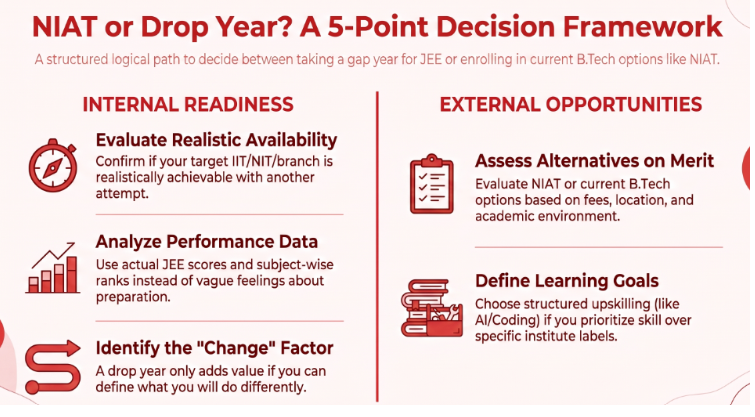
Joining NIAT Or Taking A Drop Year For JEE: A Practical Decision Framework
Instead of asking whether NIAT or a drop year is universally better, students can compare the two options across five questions.
Common Mistakes to Avoid While Making Decision
Choosing between joining NIAT and taking a JEE drop year should be based on the student's own goals, circumstances, and realistic expectations rather than comparison or assumptions. Certain common mistakes can lead to an unsuitable decision, especially when students rely too heavily on peer outcomes, placement expectations, or online reviews. Avoiding these mistakes can help students make a more informed and practical choice.
Taking a drop because of comparison with friends: A friend getting a better rank does not automatically mean another year is the right choice.
Assuming a drop guarantees a better result: One additional year provides more preparation time, but it does not guarantee a particular rank or institute.
Joining NIAT only because of placement expectations: NIAT explicitly states that enrollment does not assure a job or internship.
Choosing NIAT without researching the university: The B.Tech degree comes from the collaborating university. The university's admission, academic and degree requirements therefore need to be checked separately.
Treating online reviews as final evidence: Student discussions can reveal useful experiences, but they can also be highly individual. The same campus can produce different experiences for different students.
Conclusion
The choice between joining NIAT now and taking a drop year for JEE is ultimately a choice between two different paths: starting the undergraduate journey now with additional technology upskilling, or investing another year specifically in improving JEE performance.
A drop year has a clearer purpose when the student has a defined JEE target, remaining eligibility and a realistic preparation plan. Also, if a student wants to take ME, ECE, EEE, etc. courses, then also they should consider reattempting JEE with a proper plan. Joining NIAT can be evaluated when the student is ready to begin a university degree and wants additional structured technology upskilling in CSE with AI, ML, Data Science, alongside it.
Students should verify the current JEE eligibility rules, compare the specific university and NIAT option available to them, calculate the full financial cost of both paths, and assess their own willingness to commit to another year of preparation. That approach provides a more meaningful basis for the decision than rankings, online opinions or pressure from peers.
FAQs
1.Should a student join NIAT or take a drop year for JEE?
The choice depends on the student's JEE performance, remaining eligibility, target institute or branch, likelihood of meaningful improvement, available B.Tech options, finances and career goals. Students should definitely go for NIAT and the collaborating university model if they want to start an early career in advanced technology along with the BTech degree. Students aiming for IITs and NITs and have a proper preparation plan should definitely go for JEE.
2.Is taking a drop year for JEE worth it?
A drop year is worth evaluating when the student has a specific target, remaining eligibility and a realistic plan for improving their preparation. It should not be treated as a guarantee of a better JEE result.
3.Is NIAT a replacement for JEE?
No. NIAT and JEE serve different purposes. NIAT is an upskilling program, while JEE is an entrance examination used for admission to participating engineering programmes. NIAT uses NAT for enrollment in its upskilling programme, while university admission remains subject to the university's policies.
4.Can a student prepare for JEE after joining NIAT?
Yes, definitely. But students joining NIAT have already chosen the path where they will do the Upskilling programme and BTech degree from the University. Even after this also, if students want to appear for JEE once again, they should realistically assess their time table and study for JEE after handling university schedules and programme workload.
5.Does taking a drop year guarantee admission to IIT?
No. A drop year only provides another opportunity to prepare and appear, subject to the applicable eligibility rules. It does not guarantee an IIT seat.
6.How many times can a student attempt JEE Advanced?
Under the JEE Advanced 2026 rules, a candidate can attempt JEE Advanced a maximum of two times in two consecutive years, subject to all other eligibility conditions.
7.How many times can a student attempt JEE Main?
For the 2026 cycle, JEE Main is conducted in two sessions per year, and the applicable eligibility window spans three consecutive years, resulting in up to six sessions for an eligible candidate. Students should check the current NTA information bulletin for their specific Class 12 year.
8.Does NIAT award the B.Tech degree?
No. NIAT is not the degree-awarding body. Students receive the B.Tech degree from the collaborating university after completing the university's applicable requirements. NIAT provides a separate upskilling programme and Industry Ready Certificate.
9.Is NIAT suitable for a student who wants to focus entirely on JEE?
No. NIAT and a full-time JEE drop year involve different commitments. A student who wants to devote the year primarily to JEE preparation should take a different path and not join NIAT. However, students who want to begin their journey in advanced technology with hands-on project, and an industry-ready upskilling curriculum, should definitely consider joining NIAT and its collaborating University for the BTech degree.