NIAT, which stands for NxtWave of Innovation in Advanced Technologies, is an upskilling program by NxtWave. It focuses on industry-aligned technology skills, hands-on learning, projects, mentorship, and exposure to emerging technologies.
However, like any upskilling program, NIAT may not be the right fit for every student. The potential disadvantages are mainly related to the learning intensity, the distinction between upskilling and university academics, balancing dual programs can be a strenuous job sometimes, where students are studying their regular BTech course and along with upskilling themselves with all the hands on projects and NIAT Industry Ready Curriculum, student effort, and expectations around internships and jobs. All these can lead to the disadvantages of joining NIAT but a little bit of hard work, effort, and pushing in the right direction for 4 years can go a long way.
What Are the Disadvantages of Joining NIAT?
The main considerations are:
The learning model can be intensive.
NIAT is an upskilling program, not a degree-awarding body.
Students need to put in consistent effort outside regular learning sessions.
Career outcomes are not guaranteed by enrollment alone.
The collaborating university and NIAT have different roles.
The program may be more suitable for students interested in technology-focused learning.
Students should evaluate the overall cost and their expected return before enrolling.
These are not necessarily drawbacks for every student. For students who prefer structured, practical, and technology-focused learning, several of these characteristics can become advantages.
1. The Learning Schedule Can Be Intensive
One factor students should consider is the intensity of the NIAT upskilling program. NIAT follows a hands-on and project-based approach. NIAT has active learning, projects, technology platforms, assessments, and continuous skill development. This approach can require regular practice and consistent participation.
Why can this be a challenge?
Students who prefer a slower or primarily theory-based learning environment may initially find the pace demanding.
At the same time, the intensity is intended to help students develop practical technology skills progressively. Therefore, it can be viewed as a learning commitment rather than simply a disadvantage.
2. NIAT Does Not Award a B.Tech Degree
One of the most important points students should understand is that NIAT is not a university or a degree-awarding body.
NIAT is an upskilling initiative by NxtWave. The degree, where applicable, is awarded by the collaborating university according to its own admission and academic policies. NIAT's official website also clearly states that admission into the universities where its upskilling program is offered remains at the university's discretion.
Why is this important?
Students should not join NIAT expecting NIAT itself to provide a B.Tech degree. This distinction is important when evaluating NIAT for B.Tech aspirants. Instead, students need to understand the two roles separately:
NIAT role | Collaborating university role |
|---|---|
Provides upskilling | Provides the degree program |
Focuses on industry-oriented skills | Handles academic and admission matters |
Provides training, projects and skill development | Awards the degree, subject to its policies |
Supports practical learning | Follows its academic regulations |
3. Consistent Student Effort Is Required
NIAT's practical learning model can provide structured support, but students still need to actively participate. NIAT has project-based learning, assessments, technology platforms, and skill development. Therefore, simply enrolling in the program is not enough.
Students need to practise regularly
Students may need to spend additional time on:
Coding practice
Projects
Assignments
Assessments
Technology tools
Problem-solving
Interview preparation
Building a project portfolio
For students who are willing to practise consistently, this can become a strong part of the learning experience. For students expecting passive or lecture-only learning, it may require an adjustment.
4. NIAT Does Not Guarantee a Job or Internship
Another important consideration is career expectations. Placement outcomes depend on student effort, skills, and performance. It also explicitly states that enrollment in NIAT itself does not assure a job or internship.
However, NIAT has a network of 2,500+ companies that have hired NextWave students and describes a structured placement-support process involving skill assessment, company outreach, interview preparation, and placement support.
What does this mean for students?
Students should look at placement support as an opportunity, not a guaranteed outcome. A student's:
Technical skills
Project portfolio
Communication skills
Interview performance
Consistency
Internship experience
can influence career outcomes. Therefore, NIAT may provide career support and industry exposure, but students still need to build their own employability.
5. The Program Is Strongly Focused on Technology Skills
NIAT's upskilling program has a strong focus on areas such as AI, machine learning, data science, robotics, coding, cloud technologies, automation, and other emerging technologies. Its official curriculum and technology pages emphasise practical technology learning.
Who may find this challenging?
Students who are not interested in technology or who prefer a non-technical career path may not find the program as relevant.
On the other hand, students who want to develop technology and AI-related skills can benefit from this focused approach. Therefore, the key consideration is career alignment.
6. Students Need to Understand the University-NIAT Relationship
NIAT's upskilling program is offered at collaborating institutions. The official website currently states that the program is available at 35+ institutions across 15 cities. Students therefore need to understand that NIAT and the collaborating university have different responsibilities.
Why does this matter?
Admission to a university is subject to that university's eligibility and admission policies. NIAT does not guarantee a university seat merely because a student enrolls in the upskilling program. Students should therefore separately check:
University eligibility criteria
University admission process
Degree program
University fees
Academic facilities
Hostel and other campus facilities
Admission timelines
This helps students make an informed decision instead of assuming that the upskilling program and university degree are the same thing.
Is NIAT a Bad Choice Because of These Disadvantages?
No. These points do not automatically make NIAT a bad choice. The better approach is to understand whether the program matches the student's expectations.
NIAT may be suitable for students who:
Want practical technology learning
Are interested in AI and emerging technologies
Prefer project-based learning
Are willing to practise consistently
Want early exposure to industry-oriented projects
Understand that career outcomes depend on their own performance
It may require more consideration from students who:
Prefer only traditional classroom-based learning
Do not have an interest in technology
Expect guaranteed jobs or internships
Assume NIAT itself awards a B.Tech degree
Are not prepared to invest consistent time in skill development
Advantages and Disadvantages of Joining NIAT
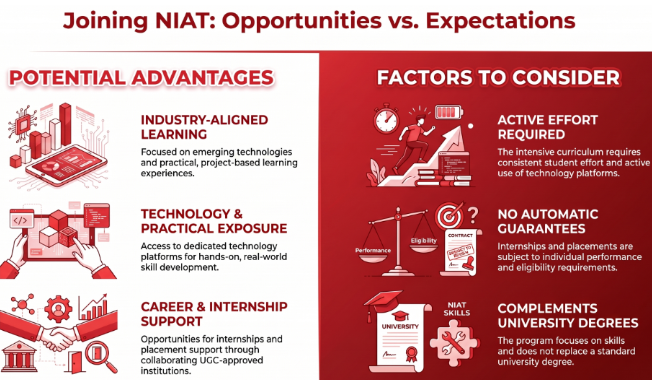
Understanding the advantages and disadvantages of joining NIAT can help students make a more informed decision about the program. NIAT focuses on industry-aligned technology skills, project-based learning, practical exposure, internships, and career support. At the same time, the learning model requires consistent effort, and outcomes such as internships and placements depend on eligibility, skills, and individual performance. The table below presents the key benefits alongside the factors students should consider before joining NIAT.
Is Joining NIAT Worth It?
Yes, despite all the challenges, it is definitely worth it to join the NIAT educational model. As technology is advancing in rapid growth where AI is helping us mostly in all our works, NIAT’s Industry ready curriculum and upskilling program that compliments the University’s traditional BTech degree is extremely helpful for the students. Any student interested in practical technology skills, projects, emerging technologies, and industry-oriented learning may find value in the program. With that said, students should definitely evaluate the collaborating university, total cost, admission requirements, and their own willingness to put in consistent effort.
Conclusion
The disadvantages of joining NIAT are better understood as factors that students should evaluate before making a decision. The program can involve an intensive learning schedule, requires consistent effort, does not guarantee internships or jobs, and should not be confused with the university's degree program. At the same time, NIAT's focus on practical learning, projects, emerging technologies, technology platforms, and industry exposure can be valuable for students who are serious about developing technology skills.
The most important point is to set the right expectations: NIAT is an upskilling program, while the collaborating university handles the degree and its admission and academic processes. Students who understand this distinction and are prepared to participate actively can evaluate NIAT more objectively and decide whether its learning model matches their career goals.
FAQs
1.What are the main disadvantages of joining NIAT?
The main considerations include the intensive learning model, the need for consistent student effort, the distinction between NIAT's upskilling program and a university degree, and the fact that internships and jobs are not guaranteed. These are not actually the disadvantages but more the challenges students can face while pursuing this course in NIAT and the collaborating University.
2.Is NIAT a university?
No. NIAT is not a university. NIAT is an upskilling initiative by NxtWave and is not a degree-awarding body.
3.Does NIAT provide a B.Tech degree?
No. NIAT does not provide a B.Tech degree. Where a student pursues a B.Tech alongside the NIAT upskilling program, the degree is awarded by the relevant collaborating university according to its policies.
4.Is NIAT suitable for students who are not interested in technology?
NIAT is primarily focused on technology-oriented upskilling. Students who do not have an interest in areas such as AI, coding, data science, robotics, or emerging technologies should evaluate whether the program aligns with their career goals.
5.Is NIAT's learning approach difficult?
The learning approach can be demanding because it involves practical work, projects, assessments, and continuous skill development. However, this can also help students develop practical skills when they participate consistently.
6.Does NIAT have its own university campus?
No. NIAT is an upskilling program and does not operate as a university with its own academic campus. Its upskilling program is offered at collaborating institutions.
7.How should students decide whether NIAT is right for them?
The decision should be based on career goals, learning preferences, university choice, budget, and willingness to practise. Students should first understand the university degree they are considering. They should then separately evaluate the value of NIAT's upskilling component. A student who wants to build technology skills alongside a university education may find the model relevant. A student who expects a conventional academic-only experience may need to understand the learning model more carefully before enrolling.